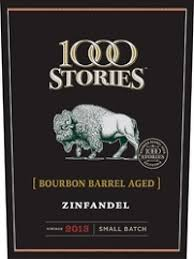
Brand litigation can be extreme in the consumer products space and even more so for alcoholic beverages (legal cannabis brand owners take note and start stockpiling your war chest).  It’s not uncommon for litigation to arise whenever an alcoholic beverage brand owner believes that another alcoholic beverage brand infringes.  Such was the case for Sazerac Company, the maker of the high quality bourbon BUFFALO TRACE.  Sazerac became concerned that Fetzer Vineyards’ use of a buffalo design and the word “bourbon” on a wine label would cause consumer confusion.


In its complaint Sazerac alleged that:

Fetzer Buffalo Design and Trade Dress are confusingly similar to Sazerac’s BUFFALO Marks and BUFFALO TRACE Trade Dress.  Each of the 1000 Stories’ bottles prominently features the Fetzer Buffalo Design, which is a sketched rendering of a standing, left-facing, fur-covered buffalo, similar to the Buffalo Logo and Buffalo Outline displayed on Sazerac’s BUFFALO TRACE product packaging.  In addition to this confusingly similar representation of a buffalo, the bottle text prominently reads “AGED IN BOURBON BARRELS,” and the website marketing specifically references the wine’s aging process in bourbon barrels from “famed distilleries,” tacitly suggesting an association with such distilleries.  It is readily apparent that Defendant chose the illustration and particular artistic stylization of a Buffalo to create a false association with Sazerac’s BUFFALO TRACE brand.

Sazerac alleged in its complaint that theirs and Fetzer’s wine would be sold in the same commercial channels – “Sazerac’s BUFFALO TRACE product and Defendant’s 1000 Stories product are competing, or will compete, in identical retail outlets – for example, wine and liquor stores, bars, restaurants, and online retail sites” – and be marketed to the same group of consumers – “Defendant, like Sazerac, markets its 1000 Stories product to adult consumers and adult purchasers of alcoholic beverage products.”

Sazerac’s claim of likelihood of confusion falls in line with the trend of the Trademark Trial and Appeals Board to find beer, wine and spirits related goods for the purposes of determining likelihood of confusion.  The TTAB has found support for this position based on third-party evidence showing manufacturers produce various types of alcoholic beverages under a single mark.  In re Uinta Brewing Company, the TTAB found persuasive eleven websites that showed breweries also selling wine; In re Sugarlands Distilling Company, LLC, the TTAB cited five examples of wineries also engaged in distillation and the sale of spirits; In re Sonoma Estate Vintners, LLC, the TTAB found persuasive fifteen registrations showing that various entities registered a single mark for wine and beer.  The TTAB also finds that alcoholic beverages are sold in the same channels of trade, such as liquor stores and restaurants, which means  that consumers will encounter multiple types of alcoholic beverages in the same stores.  The TTAB also commonly finds that consumers purchase alcohol without exercising great care.

Most often cases such as these settle.  This case, however, went all the way to a bench trial after which the judge rendered an opinion which began with the statement “In the final analysis, this case was not close.”

First the court found that Sazerac failed to establish a claim of trademark infringement.  The court noted that Sazerac relied on the “colorable imitation” theory of trademark infringement, but failed to present any evidence that Sazerac’s buffalo logo trademark creates the same commercial impression as Fetzer’s buffalo.  The court noted that Sazerac consistently argued that it was the combination of Fetzer’s buffalo and its reference to “bourbon” in “BOURBON BARREL AGED” that confused consumers as to the source of Fetzer’s wine.  This, the court noted, is a trade dress claim.

Trade dress involves the total image of a product and may include features such as size, shape, color, color combinations, texture, or graphics.  Trade dress protection is broader in scope than trademark protection, both because it protects aspects of packaging and product design that cannot be registered for trademark protection and because evaluation of trade dress infringement claims requires the court to focus on the plaintiff’s entire selling image, rather than the narrower single facet of trademark.  To establish a trade dress infringement claim, a plaintiff
must prove: “(1) the trade dress is inherently distinctive or has acquired distinctiveness through
secondary meaning; (2) there is a likelihood that the public will be confused by the infringing
use; and (3) the trade dress is nonfunctional.”

In reviewing these elements, the court found that Sazerac failed to establish that its trade dress is distinctive or that it had acquired secondary meaning.  Distinctive trade dress occurs when the trade dress is of such an unusual design that it automatically distinguishes itself from its competitors.  In finding Sazerac’s trade dress not distinctive, it found persuasive the “extensive evidence of other alcoholic beverages…that include buffalo image[s]” and that the Buffalo Trace brand has low brand recognition since it comprises only .5% of the whisky market.

Further, the court said that Sazerac failed to present evidence of direct consumer testimony or survey findings showing that its claimed trade dress had acquired secondary meaning.  While Sazerac relied on evidence showing significant marketing expenditures, the court said that Sazerac failed to demonstrate how its marketing efforts effectively created secondary meaning.

The court made quick work of analyzing the similarity of the trade dress.   While both use realistic sketched renderings of a buffalo and use the term “bourbon”, the court found that all of the other elements are different.  In the end, the court found that Sazerac failed to present any evidence that the overall appearance of Fetzer’s wine is so similar to its Buffalo Trace trade dress that it is likely to confuse consumers.

In addressing the trade channels, the court acknowledged that both bourbon and wine participate in the same general alcoholic beverage industry and are advertised and sold in overlapping channels.  However, the court found that wine and bourbon are “very distinct products” with “different alcohol contents and social uses” and they “occupy different sections of the stores where they are offered for sale.”  The court found that “the proximity or relatedness of these alcoholic beverage products may weigh slightly in Sazerac’s favor, but not significantly so.”

Lastly, the court noted that purchasers of premium alcoholic beverages tend to exercise a high degree of sophistication and care when making their purchasing decisions and cited to the 2005 Second Circuit case of Star Indus., Inc. v. Bacardi & Co. for the authority that “Unhurried consumers in the relaxed environment of the liquor store, making decisions about $12 to $24 purchases, may be expected to exhibit sufficient sophistication to distinguish between Star’s and Bacardi’s products, which are differently labeled.”  Given a $14 price point for Fetzer’s wine, the court found that “[p]urchasers of a premium red zinfandel, therefore, are expected to exercise a high degree of care and are not likely to make mistakes as to a product’s sponsorship or affiliation.

While the court’s finding of no infringement was “not close”, it will be interesting to see what effect, if any, the court’s reasoning may have on the USPTO or TTAB in refusals to register a brand for wine based on likelihood of confusion with a brand for spirits (or visa versa).  The court’s opinion guts two significant factors upon which the USPTO and TTAB have based refusals to register.

In In re Stepan Co., 2017 U.S. App. LEXIS 16246, decided August 25, 2017 the Federal Circuit Court of Appeals made it very clear that during patent prosecution, the burden of proving patent ability lies with the PTO examiner. 

The patent applicant was Stepan Co., who filed a patent application for formulas of an herbicide.  The herbicide was a composition of a glyphosate salt and a surfactant system.  The claims required the formula to have a cloud point above 70ºC or no cloud point.  The cloud point is the temperature at which a liquid turns cloudy because its components are separating.  The herbicide formulas had to have a cloud point above 70ºC to prevent the surfactants from separating.

The PTO examiner rejected all of Stephan Co.’s claims on the grounds that they were obvious over the prior art.  The prior art did not have the same cloud point or the same components, but the examiner stated that the claims were obvious because a person skilled in the art would have achieved the claimed parameters by “routine optimization” of the formula.  The examiner also found that, based on general statements in the prior art references, the skilled artisan would have been motivated to create the claimed formula.

On appeal to the Patent Trial and Appeal Board, the PTAB affirmed the examiner’s conclusion that all of Stepan Co.’s claims were obvious.  The PTAB held that Stepan Co. had not rebutted the prima facie case of obviousness established by the examiner.  The PTAB said that Stepan Co. had not produced evidence that a skilled artisan would not have achieved a cloud point above 70ºC by routine optimization.  The PTAB did not consider Stepan Co.’s evidence that the prior art references disclosed compositions that had a cloud point of 60ºC (and therefore taught away from compositions that could be used at a higher temperature).  In addition, the PTAB found that Stepan Co. did not show that a cloud point above 70ºC was critical to the compositions or that it yielded unexpected results.

On appeal, the Federal Circuit vacated the PTAB’s decision.  The court explained that in order to make a finding of obviousness, the PTO must show “that a skilled artisan would have been motivated to combine the teachings of the prior art … and that the skilled artisan would have had a reasonable expectation of success.”  These are questions of fact reviewed by the appellate court for substantial evidence.

The Federal Circuit found that the PTAB had made several errors: it did not articulate its reasoning for its finding of obviousness; it rejected Stephan Co.’s evidence of non-obviousness; and it shifted the burden of proof of patentability to the applicant.

First, the Federal Circuit held that PTAB had to explain why “routine optimization” would have produced the claimed composition.  The PTAB’s conclusion was not sufficient.  According to the court:

“Stating that a person of ordinary skill in the art would have arrived at the claimed invention through routine optimization falls short of the standard.  Missing from the Board’s analysis is an explanation as to why it would have been routine optimization to arrive at the claimed invention.  . . . [T]he Board must provide some rational underpinning  explaining why a person of ordinary person in the art would have arrived at the claimed invention through routine optimization.”

Second, the PTAB did not set forth why the skilled artisan would have had a reasonable expectation of success in modifying the prior art.  The PTO has to show that a skilled artisan “must be motivated to do more than merely vary to all parameters or try each of numerous possible choices until one possibly arrived at a successful result.”

Third, the PTAB ignored Stepan Co.’s evidence that the prior art disclosed failures that were relevant.  These failures showed why a skilled artisan would not have had a reasonable expectation of success in modifying the prior art references.

Fourth, the PTAB shifted the burden of patentability to Stepan Co.  “The PTO bears the burden of establishing a prima facie case of obviousness…. ‘Only if this burden is met does the burden of coming forward with rebuttal argument or evidence shift to the applicant.’”  The Board improperly required Stepan Co. to demonstrate why the cloud point was a critical element of the claimed composition.

Because of the PTAB’s errors, the Federal Circuit vacated the decision and remanded the case for further proceedings.

Just over two months ago, Sacramento’s beloved Firestone Public House was sued by multinational conglomerate Bridgestone Brands, LLC for trademark infringement, trademark dilution, and unfair competition based upon Firestone’s use of the FIRESTONE mark. I initially found this dispute to be quite interesting in light of what I appeared to be vastly different groups of consumers being served by the respective entities: tire consumers vis-à-vis food and beverage consumers. However, I subsequently learned that Bridgestone’s use of the FIRESTONE mark goes beyond tires and into the restaurant and bar industry, as reflected by its federally registered trademark. 

The complaint includes allegations relating to the fact that the 16th and L Street location occupied by the Firestone Public House was previously occupied by a Firestone Tire location for 75 years, and is in fact known as the Firestone Building around Sacramento, giving rise to a greater likelihood of consumer confusion. Perhaps more importantly, as mentioned above, Bridgestone owns a federally registered trademark for restaurant and bar services, which according to the U.S. Patent and Trademark Office’s file, dates back to December 1954. In its answer and counterclaim, Firestone Public House seeks to cancel Bridgestone’s mark and contends that the mark was not registered until after Firestone Public House opened. That fact, however, may be of little consequence if Bridgestone has been using the mark in commerce since 1954. In fact, Firestone’s counterclaim is likely only a strategic action taken in an attempt to gain settlement leverage. Specifically, it seems Firestone is trying to force Bridgestone to have some skin in the game so that a more favorable settlement can be reached.

It is unlikely that we will ever see this case adjudicated on the merits. Firestone, although seemingly quite a successful venture, is not nearly as well funded as Bridgestone, so it seems unlikely that it will be as willing to throw money at litigation if it can reach some form of acceptable resolution. And while Bridgestone is flush with cash, it didn’t get that way from throwing money down the drain, and it will probably reach a deal with Firestone that it can live with. After all, it doesn’t seem likely that Firestone’s use of the mark will greatly impact Bridgestone’s reputation in the restaurant and bar industry, especially since most people are unaware of Blackstone’s Firestone branded restaurants.

But with that said, it also remains possible that Bridgestone will refuse to play ball and negotiate with Firestone in good faith. It wouldn’t be the first time that a national conglomerate stepped in and tried to bully a successful, but significantly smaller company. In fact, perhaps we should expect that sort of behavior from a party who stepped in and sued a distantly located, single-location restaurant over its use of the trademark. It remains to be seen how this will shake out but we will be keeping an eye on this case, and if there are any significant developments, we will be sure to write about them.

In Eolas Technologies Incorporated v. Amazon.com, Inc., 3-17-cv-03022 (CAND August 24, 2017, Order) (Tigar, USDJ) the United States District Court for the Northern District of California recently denied plaintiff Eolas Technologies Incorporated’s (“Eolas”) motion to disqualify its former counsel, Latham and Watkins (“Latham”), as counsel for defendant Amazon.com (“Amazon”) because Eolas delayed filing its disqualification motion for over a year after it learned of the potentially conflicting representation.  The Court further found Eolas waived its disqualification argument because the delay substantially prejudiced Amazon in its defense of Eolas’ patent infringement action against Amazon. 

On November 24, 2015, Eolas filed a patent infringement action in the Eastern District of Texas against Amazon, asserting infringement by Amazon of U.S. Patent No. 9,195,507 (the “’507 patent”).  The ‘507 Patent relates generally to manipulating data in a computer network, and specifically to retrieving, presenting and manipulating embedded program objects in distributed hypermedia systems.  After the case was filed, Amazon moved to transfer the case to the Northern District of California, and, on April 28, 2017, that case was transferred.

At some point between 1998 and 2006, Latham attorneys represented Eolas in some capacity, and although the exact scope and duration of that representation is contested, Eolas claimed that “Latham was privy to all of Eolas’ proprietary and confidential information relating to its technology, patents, patent applications, business, litigation and licensing strategies, particularly those relating to the ‘906” patent, which is the parent to the ‘507 patent-in-suit.  As a result, Eolas argued Latham must be disqualified from representing Amazon because “Amazon’s defense is predicated on attacking [the ‘906 patent,] the very patent that Latham once competed to assert and later defended, and about which Latham has acquired substantial confidential and strategic information.”

As a preliminary matter, the Court first had to decide whether Texas or California law governed.  As noted, the case was originally filed in the Eastern District of Texas, as was the motion to disqualify, but the case was transferred to the Northern District of California before a decision on the motion issued.  Amazon argued that Texas law still governed.  Eolas argued that California law now applies.  The Court held that it should apply Texas law when analyzing the motion to disqualify because when Latham agreed to represent Amazon, the case was pending in the Eastern District of Texas and Latham would have been correct to expect that Texas ethical codes would apply to any motion to disqualify.  The Court then reasoned that the same law should apply now because “[a] change of venue under § 1404(a) generally should be, with respect to state law, but a change of courtrooms.”  Thus, the Court applied Texas law to the motion to disqualify.

Moving on to the substance of the motion, the Court first noted that under Texas law, “[w]aiver of a motion for disqualification of counsel is proper where the delay in moving for a disqualification is for an extended period of time, or where it is done on the eve of trial.”  However, there was a factual disagreement about when Eolas discovered Latham’s alleged conflict.  Eolas claimed that, until January 6, 2017, “nobody at Eolas knew that Latham was representing Amazon.”  Amazon, on the other hand, asserted that Eolas had known that Latham represented Amazon a year earlier, by January 2016.

The Court sided with Amazon.  Specifically, the Court noted that Latham had appeared in the case for Amazon in January 2016, and that this appearance was recognized by Eolas’ counsel.  Under Texas law, an attorney’s knowledge is imputed to a client, in this case Eolas.  The Court also noted that Eolas knew that it had previously retained Latham, including for work related to the ‘906 patent.  Therefore, the Court found Eolas knew about the Latham conflict for a year before it decided to file its motion to disqualify, and that one year qualifies as an extended delay.

The Court also found that Amazon would face substantial prejudice from Latham’s disqualification.  The Court noted that in 2016 – the year during which Eolas knew of the alleged conflict but took no action – Latham billed over 3,400 hours to defend that action and prepare the matter for trial.  The Court found this large expenditure of time and resources weighed in favor of waiver.  Thus, the Court concluded that Eolas waived its right to seek disqualification by waiting one year after discovering Latham’s conflict to file its motion, and denied the motion to disqualify Amazon’s counsel.

This case is a good reminder to timely raise all issues and potential challenges.  Otherwise, if clients and their counsel delay to long after having been found to be aware of the issue or potential challenge, a court may find it to have been waived and/or unfairly prejudicial to the other party given the delay.

My last column was the first of two columns discussing some of the most common misconceptions or myths about patents.  Here is the second part, starting with number five on my list. 

  1. A Patent Does Not Give the Patent Owner the Right to Practice the Invention.

Inventors and patent owners often assume that a patent gives them rights to practice the patented invention, i.e., freedom from infringement.  Not true.

A patent is a grant to its owner of the right to exclude others from making, using, offering to sell, and selling the patented invention in the United States, or importing the invention into the United States.  These rights are called exclusionary rights.  A patent does not provide its owner with the rights to do these things.  An invention may be patentable but still infringe another person’s patent.  In such a case, the patent owner may have a patent on the invention but cannot make or use the invention unless they obtain a license from the owner of the patent that is infringed.

  1. Patents Do Not Infringe Other Patents.

A patent cannot infringe another patent.  Only a machine, article of manufacture, composition of matter, or process can infringe a patent.

As stated above, a patent gives its owner the right to exclude others from making, using, offering to sell, selling, or importing the patented invention.  The patent is infringed if any of these acts are committed in the United States without the patent owner’s permission.  Thus, there is no infringement unless someone makes, uses, offers to sell, or sells the invention in the United States, or imports the invention into the United States.  An invention described in a patent may infringe another patent, but only if it is made, used, offered for sale, sold, or imported in the United States.  The patent itself is not an act of infringement.

  1. Patentability and Patent Infringement are Not the Same Thing.

Inventors often think that if their invention is patentable, then it cannot infringe other patents.  Not so.  Patentability and patent infringement are two different things.  An invention may be both patentable and infringe an existing patent.  In both cases, the starting point of the analysis is the claims.

To determine if an invention is patentable, the invention, as it is claimed, is compared to what is known in the field (the prior art).  In general, prior art includes written documents (such as other patents, published articles, catalogs, and websites), as well as actions by the inventor and third parties, that exist before the patent application is filed.

The first requirement of patentability is that the claims must be novel (new or different) over the prior art.  The test for novelty is performed by looking at each element of the invention as claimed.  If all of the elements of the claimed invention are present in a single prior art reference, then the invention is not novel and is said to be anticipated by the prior art.  The invention is not patentable.

The second requirement of patentability is that the claims must be nonobvious over the prior art.  The invention is obvious if the differences between the invention and the prior art are such that the invention, as a whole, would have been obvious at the time it was made to a person with ordinary skill in the art.  Unlike the test for novelty, the test for obviousness is not limited to a single prior art reference – any number of references can be combined to render an invention obvious.  For obviousness to be found, every element of the claimed invention must be present or suggested in the prior art, although not necessarily in the same reference.

To determine if an invention infringes an existing, in force (not expired) patent, the claims of the patent in question are compared to the invention (in a patent infringement action, the district court first interprets or construes the claims to determine their meaning and scope).  If each element of a claim is present in the invention (literally, or in some cases, by an equivalent), that claim is infringed.  Only one claim need be infringed for the patent to be infringed.

Thus, although it sounds counter-intuitive, an invention can be patentable over a prior art patent and, at the same time, infringe the same patent.